Showing posts with label hollywood. Show all posts

Friday, 15 November 2013

My first media hack job: "The Truth Behind the Dash for Gas"

The Truth Behind "The Truth Behind the Dash for Gas"

Talk to media people enough, and something like this was inevitable, but it seems that I am the star in a new anti-fracking documentary entitled "The truth behind the dash for gas" (my part starts from about 20 minutes in).

Back in November last year I received an email from a young guy who said he was looking to make his way as a film-maker just out from film-school. His email to me is quoted below:
I am putting together a short film about fracking in Somerset. The aim is to present a fair and informative assessment of the potential for fracking in Somerset, the risks and dangers associated with it, and the views of local people. The film and those working on it are independent of both the anti-fracking campaign groups and those who stand to gain from the fracking industry.
I think just by watching the first few minutes of the film you can see that their  claimed intent "to present a fair and informative assessment of the potential for fracking in Somerset" is barefaced lie. Even more barefaced is their claim that "the film and those working on it are independent of [...] the anti-fracking campaign groups". However, the film has a facebook page, in which it clearly states that the film is facilitated by Frack Free Somerset. The FrackFreeSomerset and FrackOff websites appear prominently in the credits at the end of the film.

Given that the very first contact between myself and the film makers was a lie, one can hardly expect the remainder of the film to do any better. I find it especially ironic that the 2nd word in the film title is "truth", while their very first contact with me was an obvious, barefaced and outright lie. It's not worth my time to address the content of the film as a whole, but I do want to comment on the parts in which my comments have been used.

Comment #1: that debate over hydraulic fracturing has descended into a media slanging match, and I don't think anyone could disagree with that. However, the film moves straight to the same science denialism more usually seen in the anti-climate-change world - if you can't trust the Royal Society for advice on scientific matters, the British Geological Survey, or the Geological Society, for matters geological, or Public Health England for public health matters, then I'm not sure where is left for you to turn, and the term conspiracy theorist begins to apply (see my final comment for more in this vein).  

As for my own 'close ties', I spent 3 months in the BP Institute in Cambridge as a 20-year-old M.Sci student. While BP provided the funds to set up the lab, the students who do projects there are  university students, and have no connection to BP (I certainly spoke to noone from BP while I was there, and in fact the majority of research being done when I was there was on developing energy efficient buildings). I also spent a few months in Rijswijk in Shell's research facility during my Ph.D. During my Ph.D I developed geophysical techniques to ensure safe storage of CO2 in geological reservoirs - so-called CCS, a potential method to mitigate climate change. During this time Shell asked my to come over and help apply some of these methods to their test site at Ketzin, Germany. All of this is made abundantly clear on my website.

Comment #2: I say that in many cases the impacts have been exaggerated. The Scranton Times-Tribune investigated claims made by residents about shale developments in Pennsylvania, finding that 77% of accusations were without substantiation. Surely an example of impacts exaggerated? Equally, even in cases where regulatory breaches by companies have lead to issues - the example of Dimock springs to mind - the impacts of this have been regularly exaggerated. At Dimock, while methane was found to have contaminated groundwater, there was no evidence of fracking fluids in the water. It's not good to have methane in groundwater, and this should be prevented from occurring at all times. However, methane is not toxic or harmful to human health, barring the risk of explosion if it allowed to accumulate in significant amounts. After the company had been cited and forced to repair its wells, levels of methane dropped, returning below the minimum safety levels set by the EPA (a fact never mentioned by activists, who will tell you that once contaminated, an aquifer can never be restored).

Comment #3: The most famous flaming tap in Gasland, the Markham well, had nothing to do with oil and gas drilling. This has been made abundantly clear by the Colorado State regulator (COGCC), which felt the need to release a comment to "correct several errors" in the film. The flaming tap is the headline image of Gasland, it appears in all the trailers and promotional material. That the gas is of biogenic origin, from shallow layers well above those targeted for drilling, implying that gas drilling is not the cause. This film attempts to argue that poor well casing still allowed shallow biogenic methane to migrate. However, the COGCC report makes clear that "there is little or no temporal relationship" between gas drilling in the area and the complaints made about the Markham and McClure wells. This is a fairly massive oversight to be made, one that I think that is worthy of comment. Clearly the film-makers find it easy to relate to other films that are economical with the truth in order to tell a story.

The regulators did rule that a drilling company was at fault in the case of the Ellsworth well. This company reached a settlement with the claimant (again, a fact that the film neglects to mention). The COGCC conducted sampling over a 170 sq mile area, and the Ellsworth well was the only one where any impact was detected. Strangely, we don't get to see Josh Fox setting the Ellsworth taps on fire - one can only guess at why?

The next sleight of hand is either quite clever, or monumentally dumb, I'm really not sure which. They move on to discuss the Duke methane studies, which I have discussed in previous posts here and here. Of course, there are a number of studies performed along along these lines, all of which come to very different conclusions to the Duke study. For some reason the film makers don't mention these (one wonders why). However, these film-makers can't even get the Duke PNAS study facts right! A screen-grab of the PNAS abstract is shown, highlighting an apparent claim that methane was found in 82% of drinking water within 1km of a gas well.
 How about we look at that section of the abstract in full:
In fact, you can clearly see that the 82% figure refers to all the water sampled, not just the ones near gas drilling sites. Methane was found in 82% of water samples, REGARDLESS OF WHETHER THEY ARE NEAR GAS WELLS OR NOT! Incidentally, this is a similar percentage to that found by Molofsky et al., who sampled a much larger dataset (1,700 samples vs 140 samples), finding that 78% of samples contained methane, regardless of proximity of gas wells. In fact this is why establishing whether shale development has caused problems is so difficult in Pennsylvania - there is already a lot of methane in the groundwater. Where studies have been conducted in areas where natural methane is not present in shallow water, they have not seen an impact from drilling.

I honestly find it hard to believe that this accidental highlighting of parts of two sentences, conveniently removing the context to make a scarier quote, is accidental. Either way it is particularly dumb to hope that people familiar with the source material won't spot the attempted trick.

Comment #4 is about well integrity. The astute among you will notice a cut in the editing between the start and end of my answer. Clearly, other things I've said have been edited out. Sadly, this interview was conducted a year ago, so I can't remember exactly what I said, and back then I was too naive to make my own recordings (not a mistake I'll make again), but presumably it was something that didn't fit with the narrative being portrayed.

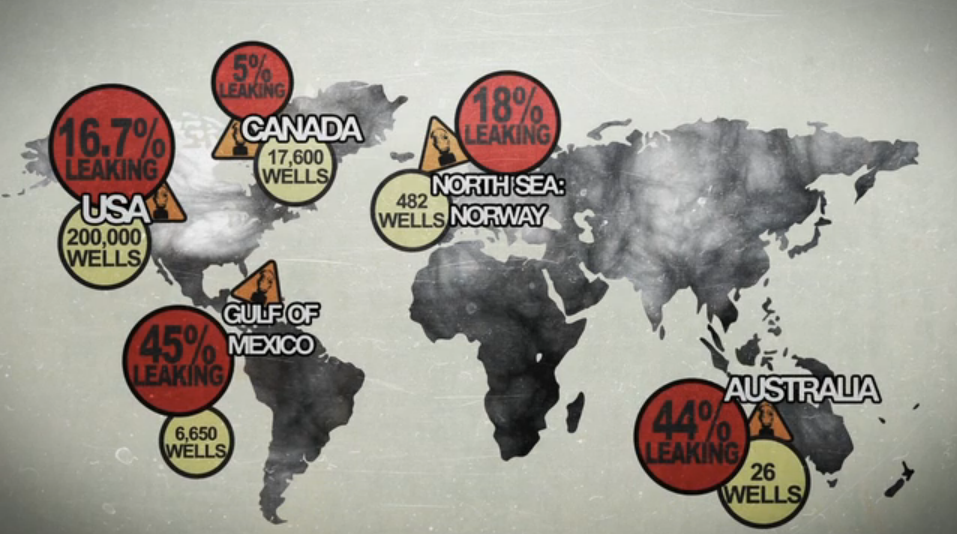
The films then cuts to the SLB Oilfield Review from 2003. Always a good litmus test of a shale gas commentator is how they treat this report. Firstly this report covers data from deep offshore in the Gulf of Mexico. This is a very challenging drilling environment, so it's not surprising to have more problems offshore than onshore. The only statistics relevant to onshore UK shale drilling are stats from other onshore wells.

More importantly, the film describes the stats as showing either "leakage" or "failure". In fact, they depict incidents of Sustained Casing Pressure. SCP isn't a good thing, and again it should be avoided, but it doesn't equate to the mass leakage of hydrocarbons into shallow layers. Categorically, these stats have no bearing on the rate at which well integrity issues are causing contamination, which is what, misleadingly, the film tries to claim.

The most obvious place to look for wellbore integrity-related contamination issues from onshore wells drilled under a UK regulatory system, is of course to look onshore in the UK, where we have drilled 2,000 wells already, many of them in the 1960s, 1970s and 1980s (making most of them 30 years old at least). One of the few things this film gets right is that whether a well is fracked or not has no bearing on wellbore integrity issues. Therefore, if the statistical claims made in this film were true, there would be 1,000 onshore contamination incidents already. If the bold claim that follows ("all wells leak eventually") were true, we'd surely have 2,000 incidents by now. Clearly the claims made in the film do not add up, because I'm not aware of any problems associated with onshore wells in the UK.

Similarly, after the Piper Alpha disaster, regulations were significantly tightened to prevent such an event ever happening again. Again, the North Sea has not been turned into an environmental wasteland - we're still so keen to eat North Sea cod that there's almost none left!

We can also look to the US, which has hundreds of thousands of onshore wells, and actually examine statistics relating to actual incidents of groundwater contamination, as opposed to SCP. Luckily, the US Groundwater Protection Council has done exactly this, in a study released in 2011. They find that of 187,000 wells drilled in Texas, and 33,000 wells drilled in Ohio, only 21 and 12 wells respectively had seen casing issues leading to contamination, rates of 0.01% and 0.04%.

Comment #5 regards regulatory differences between US and UK, and resulting differences in operating practices. The above statistics show that contamination is not endemic to shale drilling. However, even the handful of cases that have occurred is a handful too many. These few incidences are inevitably the result of poor practice, and/or the contravention of regulations.

While I'm speaking, they cut to some shots of flowback waste pits. What they fail to point out is that these are not allowed in the UK - any waste flowing back from the wells must be stored in double-lined steel tanks. This is with good reason: in the GWPC report I mention above, the majority of drilling-related contamination incidents (172 in Ohio, 190 in Texas) have come from surface activities, not from processes happening under the ground. In the US it is common to store the waste fluid in open, plastic-lined pits. These have been known to overflow during heavy rain, or for the liners to tear, allowing the contents to leak. I think the endless shots of waste-fluid pits that activists like to show indicates either that they are not aware that these are banned in the UK, or that they do know this but don't like to let facts get in the way of the story.

For example, in one well-publicised case XTO opened the valve on one of their tanks, allowing the fluid to flow out into the ground, while in another case a trucker dumped his load into a nearby storm drain, rather than taking it to the treatment plant. This sort of illegal activity should absolutely be prevented, and it is important that regulators keep a sharp eye on operators to ensure that this doesn't happen. But it doesn't show that shale gas development is inherently problematic. Again, we can look the the UK example for dealing with produced water. The existing UK onshore industry handles 70 millions barrels of produced water a year, with no apparent contamination problems.

The next interviewee, Laurence Rankin, is presented a "Former Environment Agency manager", with the obvious intention of making us think that he is an impartial commentator. Since my 3 months as a 20-year-old M.Sci student at the BP Institute is worthy of mention, maybe the film should have also pointed out that he is also a coordinator of the Sefton Green Party and member of Friends of the Earth, so perhaps slightly less impartial than first appearances might suggest. While the Green Party man seems to have a problem with Cuadrilla's activities, the Environment Agency itself doesn't, and hasn't claimed that Cuadrilla have broken any of their regulations. The fact that the Green Party man isn't familiar with fracking, doesn't mean it hasn't happened. For example, horizontal wells have been fracked at Wytch Farm in Dorset. Update - this comment reflected media reports regarding Wytch Farm. Water is injected into the Wytch Farm reservoir, but this is to increase the reservoir pressure and drive oil towards production wells (a common practice in conventional fields), not to fracture the rock.

The use of the term 'slick-water' is another slight of hand, somehow implying that slick-water is somehow worse that what has gone before. In fact, in the good old days it was common to use a mix of gelled gasoline and napalm as the frack fluid. Given the choice of water with 1% chemical additives, or gasoline and napalm as the frack fluid, the use of slick-water represents an improvement. And the fact that there were no specific references to fracking in exploration licenses is that it was considered such a normal part of oilfield and drilling activities (with 10% of existing onshore wells being hydraulically stimulated). The main difference between now and what has gone before is one of scale, with modern treatments using higher volumes, rather than any major differences in the technique itself.

The film moves on to the Cuadrilla-induced earthquake near Blackpool. The next mistake made comes with the claim that the increase in earthquakes seen in US is directly attributable to hydraulic stimulation. In fact, the increase in seismicity is caused by an increase in the volumes of waste fluids, from both conventional and unconventional operations, being disposed of by deep injection into saline aquifers. I know this because I have worked in depth on these events, including writing a report for parliament, because they have implications for CCS. There are no proposals in the UK to dispose of fracking fluids through injection into deep aquifers. As far as I am aware, we do not have suitable deep saline aquifers onshore (although we are targeting such aquifers offshore in the North Sea for CCS). Again, one is left wondering whether the film makers know this and are lying, or simply do not understand the science that is being done in this area?

There is only one case in the US where fracking has triggered seismicity - in the Eola field, Oklahoma, which occurred in January 2011, 3 months before Preese Hall event, but was not reported as such until August 2011, after Preese Hall, and one case in Canada (British Columbia), where events occurred between 2009 and 2012, although they were not reported until August 2012, a long time after Preese Hall. So Preese Hall was the first reported incident of induced seismicity triggered by hydraulic stimulation for shale gas.

With respect to reporting of the earthquake and resulting casing deformation to the Energy Minister, there was no regulatory requirement to report casing deformation to him - this is the role of the HSE. Moreover, I think the actions taken were entirely appropriate - they ceased operations to allow a 6-month scientific study to be conducted, after which the results were reported for DECC, HSE and the rest of the world to read. While we're on the point, all of the casing deformation was within the production casing string, within the target zone of production - it was actually below the depths of the frack stages that triggered the seismicity. It poses no risk whatsoever to the integrity of the well. The figure below shows the well design - the deformation is the little yellow bar right at the bottom.

I think that's it in terms of my contribution to this piece of work. I'll comment briefly on the accusation of "mission-creep" in terms of chemical use - every chemical used in the UK must be permitted by the Environment Agency, and fully disclosed to the public.

One final point in closing: the go-to 'expert' for this film appears to be Ian R. Crane, an ex-oilfield-executive, who gets the final word as far as this film is concerned. I don't usually like to stoop to ad-hom arguments, but as Mr Crane seems to appear on an increasing number of anti-fracking pieces, it'll be worth your time having a look at his profile on RationalWiki, a website dedicated to uncovering cranks, conspiracy theorists, and pseudoscience. If this is the best figure-head that the anti-fracking movement can come up with, I would suggest they need to try a little harder.

UPDATE: I checked out the FrackFreeSomerset website to look for more information. According them, the film is not just "facilitated" by FFS, but in fact "produced" by them.

UPDATE (21/11/2013): The film maker himself has left a comment for me. He is correct to point out that I failed to address my comments of water use. In the film, I describe how much water is used for a single stimulation. Of course, the issue is cumulative effects over time if many wells need to be stimulated. The water use for an individual well (~10,000 - 50,000 cubic metres) sounds like a lot, but it must be placed in context. Between the 3 largest water utilities (Severn Trent, United and Thames), 1.7 billion liters of water are lost to leaks PER DAY. If water companies were able to improve on this by just 1%, we would have available an extra 17,000 cubic metres of water, that's enough water to frack a well every day. If water consumption is your concern, don't blame frackers, get the water utilities to fix their leaks (or at least 1% of their leaks).


Monday, 24 June 2013

Horizon: Fracking, a new energy rush by Professor Iain Stewart - a review

Shale gas and fracking got the big time BBC treatment this week with the airing of Prof Iain Stewart's Horizon special. Link is here, although be quick, because the BBC don't tend to keep them up (also, you probably can't see it unless you are in the UK).

<colossal name drop> I've been fortunate enough to chat to Britain's favourite geo-celebrity before on this topic </colossal name drop>, so I knew that this was in the works, although I wasn't expecting it to hit our screens so soon.

I'm also pretty sure, unlike the author of this blog, that the views expressed genuinely represent how Iain sees the subject. I don't think, to quote, that
that Prof. Stewart was ready to burst, he was holding back so much. It was the uncomfortable way he spoke to camera, I could almost sense the person behind the camera giving him a stern look. Be balanced, be careful, this is dangerous stuff. Hang on, let’s cut to you saying nothing and driving, that’s safer.
To be fair, there WERE a lot of driving shots. It seems to be the done thing for documentaries these days. Perhaps it is assumed that unless we see shots of the presenter travelling between locations we might get confused and think they're still in the same place.

However, I don't quite understand the surprise felt by many commentators over Iain's take on the topic. The view of pretty much every professional organisation that has addressed the topic, be it the British Geological Survey, the Royal Society, the Royal Academy of Engineers, is that shale gas extraction can be conducted safely, and that risks posed are not much different to conventional hydrocarbon extraction. That's not to say that there are no risks (everything we do carries a risk), but that those risks can be managed within the UK's already robust oil and gas regulatory regime. I'm not sure why Prof Stewart, a professional geologist, would be desperate to (and I quote again)
blown his top and started ranting at the camera. ‘For pities sake, wake up, this isn’t the solution, this is shortsighted madness! We drill and pump and waste billions of gallons of fresh water extracting this stuff, we burn it, we increase carbon in the atmosphere and then it runs out. Remember ‘North Sea Gas?’ Yes it’s easy and a stopgap and a final, last ditch frenzied attempt at keeping the crumbling edifice of the fossil fuel corporations going, but it’s insane.’
I think if you only read, say, the Guardian, on shale gas, you'd be fairly convinced that fracking is completely awful, and that no-one in their right mind could support it, unless you are a greedy Texan oil baron. It must then come as a bit of shock when someone like Iain Stewart, supposedly one of the good guys, the cuddly face of geology,  takes the view (as the majority of geologists do) that the risks of shale gas extraction should be entirely manageable. Hence the rather nasty comments suggesting that either Iain, or the producers, must surely have been in the pockets of big oil to commit such an outrage.

In all I feel it was a very balanced program. The best evidence for this is that after the show, @ProfIainStewart's twitter feed was bombarded with angry commentators from both sides of the debate castigating him for making such a biased program. If you're pissing off both sides, you're probably doing a reasonable job.

The first half of the show was dedicated to the benefits of shale gas extraction.  This included a visit to a Louisiana 'shale-ionaire', a man who received a $430,000 one-off payment, plus regular monthly royalties, for drilling rights on his farmland. It also showed the scale of shale gas extraction in the US: it's not limited to Pennsylvania and Texas (although these are two hotspots). There are over 1 million wells in over 30 states. Some people believe that there is more gas in the US than there is oil in Saudi Arabia. The effects the shale gas revolution on the economy, and in particular the attraction of cheap energy to manufacturing and chemical industries that are 're-shoring' to the US was mentioned.

Particularly interesting was the visit to the National Grid control center, during the Strictly Come Dancing finale. As the show ends and everyone in the UK makes a cup of tea, the demand spikes and the Grid brings on extra power to meet this demand. I'd heard of the so-called 'TV Pickup' effect before, but it was still fascinating to see it in action. We are all so accustomed to receiving electricity quite literally at the flick of a switch, and we so rarely think about the sheer complexity of infrastructure needed to deliver it too us! It really is mind-blowing when you step back to look at it.

The scale of this infrastructure was further demonstrated by the visit to the Isle of Grain LNG terminal, where gas from Qatar is landed. The scale of the holding tanks and the size of the tankers were quite astounding - quite literally like a wall of steel as Iain describes it. The tanker is 1/4 of a mile long, and carries enough gas to power 70,000 homes for a year. Which is just as well, because 40% of our electricity comes from gas, and more than 50% of our gas is imported. This highlights the often underestimated issue of energy security - gas tankers are highly flexible, so if the Qataris ever decide to sell their gas to someone else, or someone else decides to pay a higher price for it, we'd begin to run out of gas pretty quickly. Hence the geo-political importance of 'home-grown' energy to buffer us from these consequences.

Having looked at the potential benefits, the second half of the program heads to Pennsylvania to examine some of the potential issues. Iain meets with a family, the McIntyres, who list a series of health problems that they associate with contaminated water caused by nearby gas drilling. It seems the whole community is scared of their water, and now only drink from delivered bottles. The McIntyres admit that it has been difficult to prove this link scientifically, and this comes across in the program: lots of complaints, not a lot science to back them up.

The confidential make up of drilling fluids was also mentioned. There's little doubt that drilling companies made a strategic blunder in trying to keep this information secret. There reason for doing so - the desire to keep commercial secrets from their competitors - is technically a valid one, but only if you are thinking mainly of your competitors, not the general public. Because if the public see you are keeping secrets, they will assume you have something to hide. The industry is starting to come around to this fact, and more and more wells are registered on FracFocus, but from a PR point of view this horse (and trust in the industry) has long bolted.

One of the few scientific studies that has found any kind of link between methane contamination and drilling is the famous Duke study, which receives some air time at the end of the show. It's worth bearing in mind that this study hasn't gone without substantial criticism (see here, here and here (last link is industry funded and not peer reviewed, but worth including)). This included Iain performing the now famous lighting of the water due to methane content, and the debate continues as to what extend groundwater methane is naturally occurring, and to what extent it has been exacerbated by drilling.

Overall, I think the final point is right on the money: UK shale gas operations will likely look very different to the US shale gas experience - the operating culture, the regulatory system, and the mineral rights systems are all completely different. However, it is up to British scientists and engineers to prove that they know the risks, and that they can manage the risks safely.


The thing that impressed me most about the program however, wasn't any information about shale gas. Having been involved in the topic for some time now, there wasn't a lot to surprise me. What I really enjoyed was that, perhaps unintentionally, it showcased real geoscientists doing what real geoscientists actually do.

We're not short of popular outreach in the geosciences (especially thanks to the work of Prof Stewart et al.). However, geoscience in the media tends to revolve around dinosaurs and disasters. Super-volcanoes and Stegosaurus. Tsunamis and T-Rex. In fact, only a small portion of geoscientists are palaeontologists or vulcanologists, especially in the commercial world outside of academia. This is leading to public misunderstanding of the work geoscientists do, perhaps exemplified by the incident of Iain Duncan Smith, the geologists and the shelf-stacker.

During this program, we got to see drilling engineers alongside the incredibly complex surface operations - that spaghetti-like tangle of hydraulic lines - needed to conduct a well stimulation. Such incredibly complex engineering that we rely on completely just to go about our daily lives!

We saw a geophysicist using 3D seismic data to work out where the shale rocks were, 3 to 4km beneath us, and using microseismic event locations - pops and cracks that carry no more energy than a dropped bottle of milk, detected and located with pin-point accuracy on arrays of geophones kilometers away - to map exactly how far and in what directions the stimulated fractures went. The geophysicist points out that, as the first person to look at the 3D seismic data, he really is the first living thing to 'see' these rocks since those dying organisms, whose organic matter eventually transformed into methane, were buried 350 million years ago. Astounding!

We saw Iain himself go in for a bit of palaeofacies reconstruction in some Peak District caves, using information from sedimentary structures and fossilised corals and plant matter to reconstruct the enivronmental conditions hundreds of millions of years ago, to work out where the coastline would once have been, and therefore where the best places to drill might be. What to the untrained eye might be a boring-looking grey rock, actually contains a wealth of information about what the world was like 350 million years ago!

We saw inside the BGS core store, where 250km of core samples from across the UK, logging the depths beneath our feet, are stored. We saw how electron microscopes are used to see the tiny, tiny pores within shale rocks, which may only be 5 nanometers across. These tiny pores may be pretty-much invisible to the naked eye, yet in sufficient number they allow apparently rock solid, dense shales to trap trillions of cubic meters of natural gas!

Finally, we saw hydrologists conducting water sampling across Pennsylvania. Not glamorous, perhaps, but vital work to guarantee the health and livelihoods of people who rely on that water! 

There's so much more to geoscience than the big box-office sellers: dinosaurs and natural disasters. I'm glad that, perhaps unintentionally, this program was able to show that.


Wednesday, 6 February 2013

Artists tour of shale gas in Pennsylvania

In order to draw attention to the danger of fracking, Josh Fox took the Artists Against Fracking on a tour of the Pennsylvania shale gas fields. Here's the video:


Seems innocuous enough. But this little tour has been all over the web garnering controversy, so I guess I might as well jump on the bandwagon. The tour was lead by Vera Scroggins, a local anti-gas activist. Here's what she had to say to Phelim McAleer, the director of FrackNation, when he turned up to try to interview some of the celebs:


Fairly shockingly xenophobic! Funnily enough, this doesn't make it into Josh Fox's AAF video.

Anyway, the main part of the visit was to the Mannings in Franklin Forks, which presents another interesting fracking story, fairly representative of how much things have deteriorated in these parts. I think, whether you are pro or anti, you'd have to agree that the debate surrounding it is now a big murky mess, and any semblance of trust has evaporated on both sides.

The Manning's water well began behaving strangely, with high levels of methane, and bursting from the top, as you can see in this video. Gas drilling has occurred nearby (note that the video has been posted by Ms Scroggins, her of the Irish-drunks tirade above):

Of course, WPX, the gas drilling company disputes that they are the cause of contamination. They argue that shallow natural gas accumulations are common in the area - indeed records of shallow gas seeps are found as far back as 1921, and water quality in the area is reportedly poor anyway.

WPX also claim that the strange bursting behaviour of the well is not due to the gas but due to a mechanical fault in a pump. There's video been posted video of WPX employees demonstrating the problem and attempting to fix it:

What's interesting is that there was more than one video camera at this little shindig. Vera Scroggins was there to stir the pot a bit:

The upshot now is that the lawyers are involved, and WPX employees are no longer allowed on the property.

The first thing that strikes me about these videos is that everyone has now resorted to shoving cameras in each other's faces. Everyone filming everyone else. A complete lack of trust all round.

Isotopic testing of the gas appears to suggest that the gas has a shallow origin (i.e., is not from the shale formations). However, the only results published are from WPX testing, everyone is still waiting on DEP results.

All in all, I think this shows what a mess the situation appears to have become. Communities are tearing themselves apart over this, and that's due in equal measure to the activities of both the pro- and anti- sides.

Determining water that is often naturally bad from water contaminated by fracking (and many, if not most, oil and gas fields have naturally occurring shallow accumulations) is not an easy problem. And it's a situation that is wide-open to manipulation and distortion from both sides. Plus, America being full of lawyers, things get even more complicated, to the point where everyone now seems to be videoing everyone else.

Certainly, the classic tale of little local people defending themselves from nasty big corporations is not really applicable, despite how attractive that story may be to the big Hollywood names on a day-trip from NYC. I don't think the AAF video even touches the complexity of the situation.


Wednesday, 30 January 2013

FrackNation

Sorry, been a bit lax in terms of regular posting this month. I've been a busy boy. Just quick one for now to keep you interested, which is to mention 'FrackNation', a new film that has come out recently in the US.

The aim of the film is to show the other side of the argument to Josh Fox's Gasland, which was the real start for the anti-fracking movement. Even now, when anti-fracking groups are set up, Gasland is often the first port-of-call for resources about why fracking is bad.

The film has been funded by Kickstarter, which is a crowd-sourced funding project, so it's not paid for directly by oil companies (although it wouldn't surprise me if many of the funders were people who have benefited from shale gas through leases, royalties etc).

The film has been released on US cable, but unfortunately I suspect that, short of buying the DVD, it might be a while before it is available in the UK. So in the meantime, here are a few trailers:


You can see that the film follows a similar 'intentionally-low-budget-looking' format, candid camera style popularised by the likes of Michael Moore.

Subject matter apart (and I look forward to seeing the full version, by all accounts Josh Fox and Gasland appear to have been blown out of the water), I find this style of documentary-making interesting: rushing up to people and asking them awkward questions, and no doubt employing some selective editing. I'm sure that a good journalist, combined with selective editing, could make anyone look pretty bad about pretty much anything. Usually, it's the Josh Fox's and Michael Moore's, who are from the left of the political spectrum, doing this. Now it seems those of the right (and the producer, Phelim McAleer, does appear to be fairly Conservative) are picking up on this tactic.

Anyway, enjoy the trailers, I will try to watch the full version and let you know my thoughts as soon as I can.


Thursday, 8 November 2012

The opposition to shale gas

Hats off to the Guardian once again for this article by Mariel Hemingway on why she opposes fracking. It would be easy to mock this piece for it's flighty, right-on loony-ness, but I shan't, because I'm sure the author's beliefs are held strongly and genuinely. What I will take her to task for is her sheer narrow mindedness:
Here at the Willingway, our retreat center near Malibu, my partner Bobby and I have been growing our own food and putting solar to work on our roof. It feels great to watch the meter feeding energy into the grid, instead of just pulling it out. 
Which is all well and good, and to be saluted, but really only possible if you're a wealthy Hollywood (ex?)actress. I'd love to have a solar-powered retreat near Malibu, where I could grow my food, but for the majority of normal people this simply isn't an option. I'd love to feed solar power into the grid, but I can't afford solar panels, even if I owned a house on which to put them (and I don't consider myself poor - I get paid above the national average wage). I'm not sure how the system works in the US, but in this country the feed-back into the grid is funded by feed-in tariffs (public money), so seems to me to be a useful method for richer people (who can afford to invest in these things) to get money from the tax-payer. 

Once again it's worth noting the outright falsehoods:
The hydraulic fracturing process utilizes large amounts of toxic chemicals – 10,000-40,000 gallons per wellScience has shown that it ends up in the water we drink, the water that's used on our food, and the water that nourishes fish, animals, birds, and plants
I've added the emphasis on the 'science has shown' part, partly to highlight how silly it sounds (like the 'here comes the science' part of any hair product advert), but also to point out that there is no documented case where fracking chemicals have been found in water supplies. A couple of cases of methane contamination, yes, but not the fracking chemicals. They're not buoyant, you see, so there's no force to drive them from the shale beds at 2km depth to surface waters. It'd be like making a stream flow uphill. 'Science has shown', my arse. But what's happened is that enough people have said it, and loudly enough, that it's become accepted as fact. A good example of the big lie.

She does get one thing right though:
There's nothing worse than finger-pointing – when we walk in and turn on natural gas to cook our food, or heat our house.
Anyway, I'm talking about this article because it fits very well with my latest experience with the local anti-fracking community. A couple of months ago I saw an advertised screening of Gasland at a local community center, and I thought I'd pop along, see what the anti-fracking community looked like in the south-west.

Perhaps I've spent too long around scientists, but the biggest thing that I noticed was the lack of curiosity, the lack of hunger for details. We were shown an abridged version of the film, followed by a Q & A session. Now, Gasland is notably strong on emotive filming and short on actual facts. You get to see about 5 families claiming to have been affected by gas drilling. Without context, this is fairly meaningless. The questions that anyone watching Gasland should immediately be asking are:
  • what is the incidence rate of these contamination events, in comparison to the number of wells drilled?
  • are there any other possible sources of contamination (and what is the history of water quality in the area prior to drilling?)
  • have there been methane contamination incidences like this prior to drilling?
  • have governmental agencies (like the EPA) made any comment?
  • are local communities universally opposed to drilling?
  • how does the hydraulic fracturing process actually work? How deep are the target formations? How large are the expected fractures?
Gasland gives the impression that the answers to these questions are: really high percentage, not other possible contamination sources, no prior incidents, EPA bought by industry dollars, local communities universally opposed, and no info on the process itself. In fact, I think that it'd be better characterised as: something like 0.01% incidence rate, many potential contamination sources, both natural (natural methane seepage) plus nasty leftovers from things like coal mining, many incidences of flammable water dating back centuries, EPA have investigated many sites and found no evidence of contamination, opposition to drilling is a minority in most communities, and the target formations are typically 2km deep, and fractures are typically 100-200m.

Now, I'm fairly sure that if you were to show Gasland to a group of scientists, people would be asking these questions. Scientists are trained to be sceptical, to distinguish provable fact from opinion. One of the key scientific fallacies is confirmation bias, where you selectively believe things that already fit your worldview, accepting them with a lower threshold for credibility.

I'll admit to being a victim of this myself in my work - I recently had to modify one of my papers which heavily cited another paper (by different authors) which agreed with my results, until the authors had to retract and significantly amend their work as they'd made a number of technical errors. Clearly I'd been too willing to accept their results (which agreed with mine) without properly checking that their work was accurate (for the record, my paper is still right: I had a better and more robust method for making these measurements on fracture compliance than they had). 

But my thoughts at this local anti-fracking meeting were that it was a classic case of confirmation bias. The view of the average participant was clearly that oil companies are heartless cheating bastards who spend their whole time causing awful pollution (even though we use oil every day, and for example we've had oil production in our backyard across the South of the UK for decades without any problems or issues).

So when Gasland appears to show evidence for more of this nasty oil company behaviour, it is accepted without questioning because it already fits into their worldview. Also, there was no discussion of any potential benefits: no mention of the reductions in CO2 emissions as they swap coal for gas, no mention of the shale gas possibilities in China that would represent the biggest and fastest way to reduce global CO2 emissions.

Unfortunately, I think this view is becoming increasingly entrenched, the big lie has been told loudly enough and often enough, and I think shale gas production in the UK is in for a troubled time.

I'll finish by bringing my piece full circle to mention the demographics of the meeting: I think I was pretty much the only person there under the age of 30, and I get the distinct impression that most would fit in well with Mariel Hemingway's holistic greenery. I didn't get the impression (I may be wrong of course) that the majority of people there had financial worries, or worries for the future of the economy at least in the sense that it wouldn't affect them. There's a general lack of understanding that just because they have the time, space and money for a holistic Malibu retreat (or whatever the SW UK equivalent is), the average person will not be able to follow them in this even if they wanted to. Therefore any solution to the energy and climate issues we face has to accept that the average UK citizen does not have the money to put solar power and windmills on top of their house (if they even own one, and more and more of the younger generation will never get to own a house), nor can they afford the increases in energy bills to pay to subsidise a wealthy landowner to festoon his hills with wind turbines.

So what we need are energy sources that can actually deal with the problems we face right now. I think David Miliband summed up our energy problems pretty succinctly here (skip to 49:10) - we're fussing about with energy sources that supply about 1% of our needs, when 30% of our energy comes from coal imported from Russia. The first thing we should be doing is replacing coal with gas. And that's just about the UK, so multiply this problem several times to talk about the US and China!


Friday, 28 September 2012

A few quick things....

Firstly, it seems the Guardian didn't read my last post, because they've gone and published this. I love how, when it comes to a choice between the International Energy Agency and Greenpeace on assigning the contribution shale gas has made to the US's substantial CO2 reductions since 2007, the default assumption is the Greenpeace must be right and the IEA wrong. It's not like Greenpeace have a conflict of interest in downplaying shale gas contributions to CO2 emissions reductions or anything. Meanwhile, the IEA, as an international body with a duty of care, years of experience, and who actually have environmental protection as part of their remit, can't be relied upon?

I'll let John Hanger have the last word on the matter:
http://johnhanger.blogspot.co.uk/2012/09/another-analysis-of-role-of-gas-in.html
http://johnhanger.blogspot.co.uk/2012/09/natural-gas-is-responsible-for-about-77.html
http://johnhanger.blogspot.co.uk/2012/09/10-key-facts-to-understanding-decline.html


As usual, the doom-mongers say that shale gas can't possibly have an impact on our energy markets. Maybe their models are right, but this would completely discount the on-the-ground evidence from the US, where it's had a significant impact. But anyway, maybe there won't be enough shale gas to make a dramatic impact. But it can only help push things in the right direction - shale gas production will help stabilise volatile gas markets and reduce prices by boosting supply. This effect may be large, or it may be small, but I'd rather take my chances on a small benefit that could become a larger benefit, rather than just giving up before we even begin. And if companies want to take the risk by investigating money into shale gas exploration, that's their choice (I'm sure they did at least a little bit of research on the issue before sinking all that money in).

I should add that the rumour going round is that the next BGS shale gas reserves estimate is likely to be significantly upgraded. This is just a rumour at the moment, but it wouldn't surprise me.

BTW, I do love the contradiction inherent in so many anti-shale-gas commentaries - "shale gas would contribute considerably to our greenhouse gas emissions when we should be going renewable, but anyway there's not enough shale gas there to make an impact on our energy markets, so we shouldn't bother". Well, which is it? There's either enough down there to fry us all, or there isn't and we should be perfectly happy to let these companies waste all their money looking for something that will never be economic.

Finally, an interesting blog post from the US from someone in the heart of fracking country that is well worth a read. The author talks about how the money from shale gas exploration has helped her keep the family farm going, and about the wider economic boost that the area has experienced, while pointing out how exaggerated all of the shale gas scare stories really are.

The blog begins by talking about the new Matt Damon movie, the Promised Land, which is based around shale gas (Damon plays a company man tasked with getting the locals to sign gas leases, which goes swimmingly until all the pollution kicks off). There are some interesting rumours circulating about a final twist in the plot. Apparently, the OTT environmental campaigner turns out to be a company plant intending to discredit the environmental movement by smearing its members. I've no idea whether this will turn out to be true, but it seems pretty far-fetched to me!!! I guess we'll have to see.....


Monday, 25 June 2012

Shale gas in the movies (Pt III)

This week, shale gas has hit the movies once again. I really need to get on with hiring my own director. Josh Fox, of Gasland fame, has released another short anti-shale-gas film. It's embedded here for your enjoyment:


As usual, a little balance is needed, so we'll swing to the opposite side of the political compass with a comment by EID.

The thing that struck me immediately watching this short was the apparent lack of any kind of geologist or drilling expert. The film shows papers from the standard literature that we work with everyday, but apparently he couldn't get comments from anyone? I find that surprisingly lazy if anything, because given enough beer you can usually get a geologist to come up with some kind of contrarian opinion about something. So why couldn't Josh get any geologists on film?

The other really noticeable thing is that the line of attack has completely shifted from fracking to well completion activities. I can only assume that this is a tactical retreat, a tacit acceptance that the fractures created during fracking are demonstrably too small and too deep to have any kind of influence of shallow aquifers.

And if fracking is not the problem, then the only other source of leakage must be from the well bores. Josh is right that well bores can fail. But this is a problem that we know lots about, because it's a problem in conventional gas drilling as much as it is for shale gas. So the question changes, from are you ok with having fracking going on in your back yard (and fracking sounds scary, new, dangerous) to are you ok with any gas well (conventional or shale gas) in your back yard? Which generally elicits a quite different response, because conventional gas is something people have more faith in, simply because it's been around for ages without causing many problems. For instance, Western Europe's largest onshore oil and gas field, Wytch Farm, is sited under some of the most prized and expensive real estate in the country, and noone seems bothered by it.

The failure rates cherry picked from the literature seem absurd to me:
Casing failure and leakage rates at almost 50%? Seriously? I think if we had problems in conventional gas fields on this scale, we'd really know about it? We've drilled millions of gas wells across the planet - if 50% of them had failed, we'd have contamination everywhere, most of the time. The problem stems from cherry-picking - there are plenty of reports out there that show well failure rates at 0.01%. Because the debate over shale gas has become so polarised, these numbers don't get a look in here. But it'd have been nice for Josh to at least to have gotten some geological expertise onto film to help him go through the figures.

Finally, even if failure rates were below 1%, doesn't that still sound pretty risky? Well, if well failure was a done deal "that's it, nothing we can do now" type thing, then maybe. But well casing failure is easy to detect - before you being production you run a tool down the well that detects failure. If there is failure, you do a workover to correct the damaged section. All you need to have is regulation that requires companies to do this. It'll cost them more money, and so they'll probably have a moan, but that's the kind of thing we mean when we talk about having a strong regulatory regime for shale gas extraction in the UK. Sorry Mr Company person, get that cement log running before you even think about producing from that well!

Wednesday, 13 June 2012

Shale gas in the movies (Pt II)

Despite being behind the curve in not having a shale gas film of my own, it seems I've been strangely prescient in talking about shale gas in the movies yesterday. Mere hours after my post, another shale gas movie has been announced: Truthland. Right from the font and style used in the title, you can see that this is intended to be a direct rebuttal to Gasland. In similar fashion, a folksy, homespun Pennsylvania dairy farmer takes a journey around America, talking to experts, visiting drilling sites, to find out that shale gas drilling is in fact completely fine and ok. Given that the film was funded by Energy in Depth, which in turn draws its funding from gas companies, you'd kind of expect that, but anyway, here's the trailer:

Tuesday, 12 June 2012

Coming to a cinema near you.....

With naught but a humble weblog to my name, it appears that I'm well behind the curve when it comes to talking about fracking. This year, if you want to talk about fracking, you have to do a movie.

Even Matt Damon is getting involved, with 'The Promised Land', which is a fictional story about businessmen and drilling rights in Pennslyvania. I must be careful here to not mess with Matt Damon, who in general I agree with about most things. (Aside - quality NSFW video here). But I don't have much hope that that shale gas, fracking and the people involved in the business, will come out of this well. The 'plucky-little-guy-versus-big-nasty-corporation' storyline is just too good for Hollywood to pass up.

Truth be told, I think the 'little-guy-versus-nasty-coporation' meme is so powerful in our culture that we pretty much immediately distrust anything we here from any establishment body or corporation, with little assessment of the evidence. I'm not saying that's right or wrong - there's plenty of bad stuff that's happened to warrant such mistrust - but I do wonder whether this mistrust has always been there, and whether by consistently being 'good', corporations can ever be trusted again.

Anyway, as well as the Matt Damon film, we can also look forward to Gasland II, the sequel to the much discussed Gasland movie by Josh Fox. Gasland was shredded by a few organisations, let's see what happens with the sequel.

Finally, and most interestingly, there's Fracknation. Fracknation is a crowdsourced film, meaning that the money to make it was raised from many small, individual donations. A total of 3,300 people donated an average of $60 to fund the film. The purpose of fracknation was to rebut Gasland, and show the views of the majority of people in fracking areas who support the industry for the economic boost (much like Dimock Proud). Going back to the 'little-guy-v-nasty-corporation' meme, it's interesting that these are the little guys speaking (and putting money into a film). Clearly, it's a bit more complicated than that.

I'll leave you with another video (while I go start filming my movie......)