An EU Commission report into shale gas and hydraulic fracturing has concluded that current regulations are sufficient to protect ground-water from contamination during fracking:
http://www.guardian.co.uk/environment/2012/jan/30/fracking-regulation-ec-report
Which is good news for fracking, I suppose. Now, I must admit right from the start that I'm a scientist, not a policy-maker, and my understanding of the nitty-gritty of pollution regulations isn't what it probably should be. I'm sure that, for good reasons, when you get down into it there'll be some pretty complex law-making going on. However, let me tell you why this report seems like good, albeit rather obvious news to me. And it has nothing to do with shale gas and fracking.
Presumably, regulations should already be in place that state pretty clearly - if you do anything to cause pollution and contamination of ground-water (which can eventually end up in rivers, lakes, the sea, sensitive wetlands, and our drinking water), whether it's hydraulic fracturing or whatever other engineering process, I want you to be punished severely for it!
If, tomorrow, I invent some new process (let's call it 'bogswaddling', for want of a better name) then from the moment I first invent it, it should be covered by pre-existing legislation which says 'DO NOT POLLUTE GROUNDWATER SUPPLIES', no matter what you're up to. I don't want to wait for the EU to come up with some new laws specially for the bogswaddling. Creating new laws specifically for bogswaddling would probably provide the perfect opportunity for lobbyists on behalf of the bogswaddling industry to come in, do some lobbying and get some sort of exceptions or loop-holes. Why not just have laws that say 'NO POLLUTING OR MASSIVE FINES', doesn't matter whether you're fracking, bogswaddling or anything else.
So I'm glad that it appears that we already have legislation in place to ensure that Cuadrilla et al. won't be allowed to create pollution. I'm surprised that it would be an issue in the first place.
Now I'll sit back and wait for someone with a better understanding of the legislative side of things to explain to me why I'm wrong.....
Tuesday, 31 January 2012

Monday, 30 January 2012
Academic Genealogy
After reading this AGU blog on academic genealogy, I couldn't resist weighing in with some genealogy of my own. You academic genealogy works something like a family tree, but rather than father-son relationships, it's all about who supervised who during the course of their PhDs.
So - my academic genealogy:
Firstly, a quick mention to Glenn Jones - my academic brother, now studying ice-quakes at Swansea University. We shared many a great time (and some not so great times) being supervised by Bristol big-wig Prof. Mike Kendall:
 Mike, a Canadian, did his PhD at Queens University, Canada, under the supervision of Colin Thompson (now at Queens), a specialist in the nitty-gritty of modelling seismic waves. In turn, Colin did his PhD back in the UK, in my own alma mater of Cambridge, supervised by Dave Gubbins, now at Leeds:
 It gets very Cambridge-centric from here on in: Gubbins also completed his PhD at Cambridge, under the supervision of one of the BIG names in geophysics, Edward Bullard:
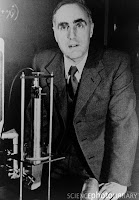
Bullard was one of the key names during the discovery of plate tectonics. Pretty neat huh! He in turn was supervised by Patrick Maynard Stuart Blackett. Blackett spent a fair bit of time with Ernest Rutherford, who first split the atom, and is considered one of the fathers of radioactivity, and won a Nobel prize for Chemistry:
 Rutherford worked under JJ Thompson, he who discovered the electron! Thompson worked under John Strutt, Lord Rayleigh, who among many other things, gives his name to Rayleigh waves (a type of seismic wave that travels along the surface of the earth (rather than through it, like P and S waves).
I'm going to speed up a bit, because there's a few names I don't really know. I've found this information from the Mathematics Genealogy website, well worth a browse if you're an academic. Rayleigh was advised by Edward Routh, and, following the biblical style (only getting older rather than younger) Routh begat William Hopkins, who begat Adam Sedgwick. We'll pause for a moment on Sedgwick:
 Considered to be one of the founding fathers of the modern science of geology, Sedgwick was, among others, the tutor of Charles Darwin. The student geology society at Cambridge is named after him, as is the Cambridge Natural History museum. Onwards with our genealogy, Sedgwick begat Thomas Jones, who begat Thomas Postlethwaite, who begat Stephen Whisson, who begat Walter Taylor, who begat Robert Smith, who begat Roger Cotes. And Cotes was supervised by none other than Isaac Newton himself:
 So Isaac Newton is my academic great-great-great-great-great-great-great-great-great-great-great-great-great-great-great-great-great-grandfather. That's 17 greats. So, academic great^17 - grandfather. HOW COOL! I think that blows our AGU blogger friend out of the water!
It's interesting to note the progression - we move pretty quickly from geophysics into proper, hardcore physics. There's a brief outpost of geology in Adam Sedwick, and then back to the grandfather of all modern physics, Isaac Newton. I guess that pretty much describes in a nutshell the history of geophysics as a science. It's also interesting to note how quickly everything becomes very Cambridge-centric.
While it's tempting to be proud of such an illustrious academic lineage, it's actually rather depressing. While my forbears were: inventing calculus and discovering the principles of gravitation (Newton, amongst many other things obviously); cataloging and defining the geological time periods we still use today (Sedgwick); discovering electro-magnetic scattering and a type of seismic wave (Rayleigh); discovering the electron and inventing the mass spectrometer (JJ Thompson); splitting the atom (Rutherford); discovering plate tectonics (Bullard); or just being a very cool, laid-back Canadian who looks a lot like Bruce Willis (Kendall); the sum total of my career so far is to piddle about with some aspects of hydraulic fracturing in the hope of making some incremental improvements to how we monitor and model fracks. It seems so small and parochial compared with the fabulous achievements of my forbears (and, while I'm at it, the kind of discoveries we're seeing coming out of places like CERN).
However, from my stats page it seems like someone out there at least has been reading my blog. Either it's my mother (hello mum, I promise to call again soon) or people are interested in fracking, and want to be sure that if fracking goes ahead, we're capable of monitoring it to ensure it is done safely and with minimum risk. So I guess I won't throw in the towel just yet.
So - my academic genealogy:
Firstly, a quick mention to Glenn Jones - my academic brother, now studying ice-quakes at Swansea University. We shared many a great time (and some not so great times) being supervised by Bristol big-wig Prof. Mike Kendall:


Bullard was one of the key names during the discovery of plate tectonics. Pretty neat huh! He in turn was supervised by Patrick Maynard Stuart Blackett. Blackett spent a fair bit of time with Ernest Rutherford, who first split the atom, and is considered one of the fathers of radioactivity, and won a Nobel prize for Chemistry:

I'm going to speed up a bit, because there's a few names I don't really know. I've found this information from the Mathematics Genealogy website, well worth a browse if you're an academic. Rayleigh was advised by Edward Routh, and, following the biblical style (only getting older rather than younger) Routh begat William Hopkins, who begat Adam Sedgwick. We'll pause for a moment on Sedgwick:


It's interesting to note the progression - we move pretty quickly from geophysics into proper, hardcore physics. There's a brief outpost of geology in Adam Sedwick, and then back to the grandfather of all modern physics, Isaac Newton. I guess that pretty much describes in a nutshell the history of geophysics as a science. It's also interesting to note how quickly everything becomes very Cambridge-centric.
While it's tempting to be proud of such an illustrious academic lineage, it's actually rather depressing. While my forbears were: inventing calculus and discovering the principles of gravitation (Newton, amongst many other things obviously); cataloging and defining the geological time periods we still use today (Sedgwick); discovering electro-magnetic scattering and a type of seismic wave (Rayleigh); discovering the electron and inventing the mass spectrometer (JJ Thompson); splitting the atom (Rutherford); discovering plate tectonics (Bullard); or just being a very cool, laid-back Canadian who looks a lot like Bruce Willis (Kendall); the sum total of my career so far is to piddle about with some aspects of hydraulic fracturing in the hope of making some incremental improvements to how we monitor and model fracks. It seems so small and parochial compared with the fabulous achievements of my forbears (and, while I'm at it, the kind of discoveries we're seeing coming out of places like CERN).
However, from my stats page it seems like someone out there at least has been reading my blog. Either it's my mother (hello mum, I promise to call again soon) or people are interested in fracking, and want to be sure that if fracking goes ahead, we're capable of monitoring it to ensure it is done safely and with minimum risk. So I guess I won't throw in the towel just yet.
Friday, 13 January 2012
Shale gas and BGS blogs....
A quick post before the weekend. The BGS (British Geological Survey) are getting into shale gas, which is definitely a good thing - the more scientists around the better. However, this blog post by the Executive Director has me all wound up (probably more than it's worth):
http://britgeosurvey.blogspot.com/2011/12/british-geological-survey-shale-gas.html
Specifically, the line 'the gas is tightly bound to silt and sand grains and needs to be pushed out by injection in a process that is called fracking' has got me annoyed, because it appears that the BGS Executive Director doesn't know what fracking is.
Firstly, the gas is not tightly bound to the silt - that implies some sort of chemical bonding between the gas and the shale. While this might happen to some extent, the majority of the gas exists as a free phase within the pores of the shale. Despite a low permeability, shale can easily have a porosity of 10%. This means that the gas is there as a free phase, trapped in the spaces in the rock, but the low permeability stops it going anywhere.
This is where fracking comes in - by creating fractures in the rock, the gas can escape from its shale cage and flow down the fractures to the well, where it is produced. Yes, fracking requires injection, because the fractures are created by pumping in water at high pressure until the tensile strength of the rock is exceeded. However, this all takes place over an hour or so. After that, with the fractures created the gas flows out naturally along the fractures due to the pressure differential between the formation and the well (just like conventional gas and oil), and continues to do so for several years without further stimulation or fracking. The gas does not need to be 'pushed out by injection'.
The BGS blog implies that continuous injection and activity is needed to squeeze the gas out from the rock. This sort of impression will make shale gas seem far less attractive to the general public - continuous activity and injection for years of production, and some sort of weird chemical interaction. Rather than what actually happens: frack once (taking maybe a week or so to complete all the stages in a horizontal well), then leave the well to produce naturally for years.
However, in their defense, the web resource which the blog was advertising - the BGS's new shale gas web page, does look like a useful store of shale gas information.
http://britgeosurvey.blogspot.com/2011/12/british-geological-survey-shale-gas.html
Specifically, the line 'the gas is tightly bound to silt and sand grains and needs to be pushed out by injection in a process that is called fracking' has got me annoyed, because it appears that the BGS Executive Director doesn't know what fracking is.
Firstly, the gas is not tightly bound to the silt - that implies some sort of chemical bonding between the gas and the shale. While this might happen to some extent, the majority of the gas exists as a free phase within the pores of the shale. Despite a low permeability, shale can easily have a porosity of 10%. This means that the gas is there as a free phase, trapped in the spaces in the rock, but the low permeability stops it going anywhere.
This is where fracking comes in - by creating fractures in the rock, the gas can escape from its shale cage and flow down the fractures to the well, where it is produced. Yes, fracking requires injection, because the fractures are created by pumping in water at high pressure until the tensile strength of the rock is exceeded. However, this all takes place over an hour or so. After that, with the fractures created the gas flows out naturally along the fractures due to the pressure differential between the formation and the well (just like conventional gas and oil), and continues to do so for several years without further stimulation or fracking. The gas does not need to be 'pushed out by injection'.
The BGS blog implies that continuous injection and activity is needed to squeeze the gas out from the rock. This sort of impression will make shale gas seem far less attractive to the general public - continuous activity and injection for years of production, and some sort of weird chemical interaction. Rather than what actually happens: frack once (taking maybe a week or so to complete all the stages in a horizontal well), then leave the well to produce naturally for years.
However, in their defense, the web resource which the blog was advertising - the BGS's new shale gas web page, does look like a useful store of shale gas information.
Monday, 9 January 2012
H-Factors and Citation Metrics
Interesting article in the Guardian this week about h-indexes, and citation metrics in general. Not a fracking related post, but citation metrics are never far from the mind of any ambitious academic.
http://www.guardian.co.uk/commentisfree/2012/jan/06/bad-science-h-index
Citation metrics are how academics, such as myself, are judged. There are a number of different systems, all of them broadly based on the number of citations you receive. So before I go any further I guess I should explain what a citation is:
Science never operates in a vacuum, we are always utilising, building on, confirming (or disproving) pre-existing theories. So when scientists write academic papers to be published in academic journals, they cite the work of previous scientists on whose work has relevance to the new paper. For instance, to quote from a paper I am writing at the moment:
If a paper is good, interesting, exciting, provides a good method that other scientists will use, then it will tend to attract a lot of citations. So in short, the more citations you have, the better scientist you are. Good papers get cited, crap ones get ignored. This is the way the scientific community as a whole pass judgement on the work of each scientist as an individual.
Obviously, this doesn't always go quite to plan - for example a paper may attract a lot of citations for being wrong, so people will cite it as an example of what not to do. You also tend to get so-called 'copycat' citations - lets say a big name author cites a particular paper. Now this paper may not be all that great, the big name author only cited it because he/she was in a bit of a rush and it kind of fitted the bill for something he/she was saying. However, when everyone reads the big name author's paper they see this citation and begin citing it as well, creating a lot of citations for a paper that wasn't actually all that worthy.
Nevertheless, despite these issues, I don't think I've seen a better way of objectively assessing a paper's quality than by counting the number of times it's cited.
The crudest citation metric is simply to count the number of citations you have for all your papers, or the average number of citations per paper. However, a more sophisticated method is the h-index. Your h-index is the number (h) of papers you have that have been cited at least h times. So, in my case, I have 14 publications at present (listed here. By listing them in order of the number of times they have been cited, we can compute my h-index.
So I have at least 4 papers that have been cited more than 4 times, meaning that my h-index is 4. I do not have 5 papers that have been cited 5 times. Once one of papers 5,6 or 7 get cited one more time, I'll have an h-index of 5 (yay!). My h-index is pretty low, for two reasons - firstly I'm a very young scientist, so most of my papers have only been published in the last couple of years - there hasn't been time for other scientists to read them, use them and then cite them (you'll notice that my most cited papers are pretty much the oldest ones). Secondly, I work in applied geophysics, which historically has a pretty poor citation rate. This is because a paper can have a big impact, and lots of people from BP, Shell, Exxon etc will use it to get oil and gas out of the ground. However, these people don't write papers saying how useful your paper was in helping them do this, they just laugh all the way to the bank. They might thank you in person at a conference, they might even sponsor your research, but they won't write a paper and cite you, meaning that a really significant applied geophysics paper my not be particularly well cited.
This variance between disciplines is often given as one of the major problems with citation metrics, but it doesn't bother me so much, as I'm unlikely to be competing with a biologist (who tend to cite each other a lot, so have much higher h-indexes) for a job any time soon. However, it is true that your h-index can be important when a potential employer is sifting through 50 applicants for one position. While a good h-index alone won't be enough to get you a job, a poor h-index can be enough to see you rejected.
I'll bring this rather rambling post to a close now. Some scientists really loathe citation metrics (have a look the comments section in the Guardian article). Personally, I don't really have a strong view. I can see the validity of the points made against it - there will certainly be individual cases where the h-index does a very poor job of representing ability. However, I think we must accept that there are now too many academics in the world for us all to be assessed as individuals - it would simply take too much time, and be too subjective. So as a general rule, I guess a citation metric provides a decent overview, although we must always be prepared to consider individual cases on their merits in certain situations.
P.S. This issue of subjectivity has inspired me to write a little more. Before citation metrics, the ability to negotiate the (often extremely petty, underhand and subjective) world of academic politics in order to ensure you got a shot at the best jobs and funding opportunities (i.e., that person gave my paper a bad review or slagged it off in their paper, so I'm going to slag off their funding application). While citation metrics aren't perfect, they do at least help guard against this sort of thing.....
http://www.guardian.co.uk/commentisfree/2012/jan/06/bad-science-h-index
Citation metrics are how academics, such as myself, are judged. There are a number of different systems, all of them broadly based on the number of citations you receive. So before I go any further I guess I should explain what a citation is:
Science never operates in a vacuum, we are always utilising, building on, confirming (or disproving) pre-existing theories. So when scientists write academic papers to be published in academic journals, they cite the work of previous scientists on whose work has relevance to the new paper. For instance, to quote from a paper I am writing at the moment:
The magnitude of the fracture compliance is usually scaled to the number density and length of the fractures (e.g., Hudson, 1981). At the end of the paper there will be a full list of all the papers cited, giving the journal, volume, page number, etc of each cited paper.
If a paper is good, interesting, exciting, provides a good method that other scientists will use, then it will tend to attract a lot of citations. So in short, the more citations you have, the better scientist you are. Good papers get cited, crap ones get ignored. This is the way the scientific community as a whole pass judgement on the work of each scientist as an individual.
Obviously, this doesn't always go quite to plan - for example a paper may attract a lot of citations for being wrong, so people will cite it as an example of what not to do. You also tend to get so-called 'copycat' citations - lets say a big name author cites a particular paper. Now this paper may not be all that great, the big name author only cited it because he/she was in a bit of a rush and it kind of fitted the bill for something he/she was saying. However, when everyone reads the big name author's paper they see this citation and begin citing it as well, creating a lot of citations for a paper that wasn't actually all that worthy.
Nevertheless, despite these issues, I don't think I've seen a better way of objectively assessing a paper's quality than by counting the number of times it's cited.
The crudest citation metric is simply to count the number of citations you have for all your papers, or the average number of citations per paper. However, a more sophisticated method is the h-index. Your h-index is the number (h) of papers you have that have been cited at least h times. So, in my case, I have 14 publications at present (listed here. By listing them in order of the number of times they have been cited, we can compute my h-index.
| Paper Number | Year | Number of Citations |
| 1 | 2008 | 16 |
| 2 | 2009 | 9 |
| 3 | 2010 | 6 |
| 4 | 2010 | 5 |
| 5 | 2007 | 4 |
| 6 | 2009 | 4 |
| 7 | 2010 | 4 |
| 8 | 2011 | 2 |
| 9 | 2011 | 2 |
| 10 | 2011 | 2 |
| 11 | 2011 | 1 |
| 12 | 2011 | 0 |
| 13 | 2011 | 0 |
| 14 | 2011 | 0 |
So I have at least 4 papers that have been cited more than 4 times, meaning that my h-index is 4. I do not have 5 papers that have been cited 5 times. Once one of papers 5,6 or 7 get cited one more time, I'll have an h-index of 5 (yay!). My h-index is pretty low, for two reasons - firstly I'm a very young scientist, so most of my papers have only been published in the last couple of years - there hasn't been time for other scientists to read them, use them and then cite them (you'll notice that my most cited papers are pretty much the oldest ones). Secondly, I work in applied geophysics, which historically has a pretty poor citation rate. This is because a paper can have a big impact, and lots of people from BP, Shell, Exxon etc will use it to get oil and gas out of the ground. However, these people don't write papers saying how useful your paper was in helping them do this, they just laugh all the way to the bank. They might thank you in person at a conference, they might even sponsor your research, but they won't write a paper and cite you, meaning that a really significant applied geophysics paper my not be particularly well cited.
This variance between disciplines is often given as one of the major problems with citation metrics, but it doesn't bother me so much, as I'm unlikely to be competing with a biologist (who tend to cite each other a lot, so have much higher h-indexes) for a job any time soon. However, it is true that your h-index can be important when a potential employer is sifting through 50 applicants for one position. While a good h-index alone won't be enough to get you a job, a poor h-index can be enough to see you rejected.
I'll bring this rather rambling post to a close now. Some scientists really loathe citation metrics (have a look the comments section in the Guardian article). Personally, I don't really have a strong view. I can see the validity of the points made against it - there will certainly be individual cases where the h-index does a very poor job of representing ability. However, I think we must accept that there are now too many academics in the world for us all to be assessed as individuals - it would simply take too much time, and be too subjective. So as a general rule, I guess a citation metric provides a decent overview, although we must always be prepared to consider individual cases on their merits in certain situations.
P.S. This issue of subjectivity has inspired me to write a little more. Before citation metrics, the ability to negotiate the (often extremely petty, underhand and subjective) world of academic politics in order to ensure you got a shot at the best jobs and funding opportunities (i.e., that person gave my paper a bad review or slagged it off in their paper, so I'm going to slag off their funding application). While citation metrics aren't perfect, they do at least help guard against this sort of thing.....
Wednesday, 4 January 2012
Perspective
In writing my last post, I began thinking about how important perspective can be in our view of a given topic. Some instances:
However, a sense of perspective can be achieved by considering the work of some colleagues of mine who are working on a project called 'SPICE' - Stratospheric Particle Injection for Climate Engineering. We are currently looking at the possibility of constructing a huge pipeline into the stratosphere, through which we can pump sulphate particles that will help absorb the sun's rays and reduce global warming to manageable levels. When you consider that plan B is a 25km space-pipe injecting sulphate into the stratosphere, wouldn't it be a better idea to start burying CO2 emitted from power plants now, rather than hoping that we will switch to renewable energy at some unspecified point in the future. Perspective people......
- if you came from a planet that had never burned fossil fuels (or from our planet but 300 years ago) you'd probably find the whole notion of burning fossil fuels on the scale we do to be abhorrent, what with the pollution, oil spills, global warming etc. However, we are accustomed to it, so it doesn't bother (most of) us.
- If you're used to your hydrocarbons coming nice and easily from a Saudi field (where the method of extraction is pretty much stick a hole in the ground, let the light, sweet crude oil flow up with hardly any effort at all) then things like shale gas, hydrofracking and tar sands seem crazy.
- However, if someone is considering burning coal from underneath your feet (UCG, see my previous post), suddenly shale gas doesn't seem so bad after all.
However, a sense of perspective can be achieved by considering the work of some colleagues of mine who are working on a project called 'SPICE' - Stratospheric Particle Injection for Climate Engineering. We are currently looking at the possibility of constructing a huge pipeline into the stratosphere, through which we can pump sulphate particles that will help absorb the sun's rays and reduce global warming to manageable levels. When you consider that plan B is a 25km space-pipe injecting sulphate into the stratosphere, wouldn't it be a better idea to start burying CO2 emitted from power plants now, rather than hoping that we will switch to renewable energy at some unspecified point in the future. Perspective people......
Underground Coal Gasification
Good evening readers and welcome to 2012. I write having just seen this report on Channel 4 news about Underground Coal Gasification (UCG). I found it fascinating, and I must admit that, for someone who claims to be in-the-know about this sort of thing, it caught me somewhat by surprise. It seems developers are keen to give the technique a go in the Swansea area, which was news to me.
So, what is UCG? Let's ask wikipedia. In short, the basic idea is that you take a coal seam that is too deep or too thin to mine, and inject oxygen. The oxygen combusts with the coal (at temperatures of 700C or more), producing CO2, CO, H2 and CH4. Once produced, the CH4 and H2 are burned to produce energy. Yes, you heard correctly, we're going to drill down into some coal seams, pump in oxygen and then set the coal on fire! It's so crazy, it just might work! Actually, it does work, but obviously there are issues of groundwater contamination, air pollution (CO2 'only' causes global warming, CO is far nastier stuff) and subsidence.
But wait - there's more! UCG is not the only process where we set fire to hydrocarbons while they're still in the ground. One method of extracting heavy (very viscous) oil is a process called Toe-Heel Air Injection (THAI). By injecting oxygen and burning a portion of the hydrocarbon, we increase the temperature of the rest of the oil, 'melting' it, making it less viscous, and therefore easier to suck out through the production well. Here's a picture:

An aside: sometimes the things we do in pursuit of hydrocarbons blows my (admittedly tiny) brain! As an engineer/scientist, I'm proud and amazed that humanity is capable of doing such incredible things. From a more social/environmental angle, I'm disgusted that our addiction to oil has forced us to do such incredible things.
However, my main interest in discussing UCG is to make a comparison with hydraulic fracturing and shale gas. Firstly, note that in order to generate sufficient permeability in the coal beds, fracking will almost certainly be required for UCG as well. Now consider that in shale gas the workflow goes something like: drill - frack - produce the gas. For UCG it goes: drill - frack - inject oxygen - combust coal at 700C - produce gas (as well as CO2 and CO, and smaller amounts of sulphur oxides etc). From a global warming perspective, I'd be surprised if UCG (which is, ultimately, coal-based) doesn't produce a lot more CO2 than shale gas. I'd be more worried about the possibility of CO leakage (although in my brief trawl of the internet I've not seen this raised as a major issue). Also, the volume of the remnants (coal ash) is less than the initial volume of untreated coal, creating the possibility of subsidence during production.
The combination of heating and possible subsidence means that controlling fracture propagation during UCG could be a serious challenge. If you want to stop a hydraulic frack (as for shale gas), you turn the pump off, draw down the pressure and it stops. Not so sure how you'd stop fracturing caused by an overheated zone, or by subsidence. Fractures can provide pathways for fluids to migrate beyond the target zone. So if you can't control your fractures, how can you ensure that any potential pollutants stay 'in-zone' and do not escape, to eventually end up in someone's water supply?
With these disdvantages, I find it difficult to believe that UCG can be as safe, as controlled, with a lower environmental impact (both local air and water quality, and global GHG emissions) as shale gas. However, what it does have going for it (in the UK at least) is that it will likely happen in areas accustomed to large scale coal mining, meaning the people there are less likely to complain about new industrial developments, and these are regions that, with the decline of the UK coal industry, are more likely to take the opportunities for jobs and economic development over environmental concerns. In contrast, the major shale gas areas considered so far - Fylde, the Mendips, the Vale of Glamorgan, Kent - are some lovely unspoilt areas of countryside, and are also much more prosperous, and so the local people there are far more likely to object to shale gas (or any other industrial) developments.
I think it'll be very interesting to see how these things play out. Will we go for both shale gas and UCG? One or the other, or neither?
So, what is UCG? Let's ask wikipedia. In short, the basic idea is that you take a coal seam that is too deep or too thin to mine, and inject oxygen. The oxygen combusts with the coal (at temperatures of 700C or more), producing CO2, CO, H2 and CH4. Once produced, the CH4 and H2 are burned to produce energy. Yes, you heard correctly, we're going to drill down into some coal seams, pump in oxygen and then set the coal on fire! It's so crazy, it just might work! Actually, it does work, but obviously there are issues of groundwater contamination, air pollution (CO2 'only' causes global warming, CO is far nastier stuff) and subsidence.
But wait - there's more! UCG is not the only process where we set fire to hydrocarbons while they're still in the ground. One method of extracting heavy (very viscous) oil is a process called Toe-Heel Air Injection (THAI). By injecting oxygen and burning a portion of the hydrocarbon, we increase the temperature of the rest of the oil, 'melting' it, making it less viscous, and therefore easier to suck out through the production well. Here's a picture:

An aside: sometimes the things we do in pursuit of hydrocarbons blows my (admittedly tiny) brain! As an engineer/scientist, I'm proud and amazed that humanity is capable of doing such incredible things. From a more social/environmental angle, I'm disgusted that our addiction to oil has forced us to do such incredible things.
However, my main interest in discussing UCG is to make a comparison with hydraulic fracturing and shale gas. Firstly, note that in order to generate sufficient permeability in the coal beds, fracking will almost certainly be required for UCG as well. Now consider that in shale gas the workflow goes something like: drill - frack - produce the gas. For UCG it goes: drill - frack - inject oxygen - combust coal at 700C - produce gas (as well as CO2 and CO, and smaller amounts of sulphur oxides etc). From a global warming perspective, I'd be surprised if UCG (which is, ultimately, coal-based) doesn't produce a lot more CO2 than shale gas. I'd be more worried about the possibility of CO leakage (although in my brief trawl of the internet I've not seen this raised as a major issue). Also, the volume of the remnants (coal ash) is less than the initial volume of untreated coal, creating the possibility of subsidence during production.
The combination of heating and possible subsidence means that controlling fracture propagation during UCG could be a serious challenge. If you want to stop a hydraulic frack (as for shale gas), you turn the pump off, draw down the pressure and it stops. Not so sure how you'd stop fracturing caused by an overheated zone, or by subsidence. Fractures can provide pathways for fluids to migrate beyond the target zone. So if you can't control your fractures, how can you ensure that any potential pollutants stay 'in-zone' and do not escape, to eventually end up in someone's water supply?
With these disdvantages, I find it difficult to believe that UCG can be as safe, as controlled, with a lower environmental impact (both local air and water quality, and global GHG emissions) as shale gas. However, what it does have going for it (in the UK at least) is that it will likely happen in areas accustomed to large scale coal mining, meaning the people there are less likely to complain about new industrial developments, and these are regions that, with the decline of the UK coal industry, are more likely to take the opportunities for jobs and economic development over environmental concerns. In contrast, the major shale gas areas considered so far - Fylde, the Mendips, the Vale of Glamorgan, Kent - are some lovely unspoilt areas of countryside, and are also much more prosperous, and so the local people there are far more likely to object to shale gas (or any other industrial) developments.
I think it'll be very interesting to see how these things play out. Will we go for both shale gas and UCG? One or the other, or neither?
Saturday, 17 December 2011
Earthquakes near Blackpool
So, we've established that fracking won't cause volcanoes. But what about earthquakes? It's well known now that fracking activities appear to have produced two earthquakes at the Cuadrilla site near Blackpool. These earthquakes - in April and May 2011 - had magnitudes of 1.7 and 2.5. Earthquakes of this size have never been experienced during fracking before, so it's really interesting to have a look at them.
Firstly, how do their magnitudes correspond to what has gone before, and what earthquakes are like in nature. All fracking produces 'microearthquakes' - these are just like earthquakes except, as you'd guess from the name, much smaller. Typical earthquakes during fracking have magnitudes of -3 to 0. These are too small to be felt at the surface, even by a seismogram. However, geophysicists like myself will place geophones down boreholes near to the fracture stimulation to detect these microearthquakes, and use their locations to map the course of the fracture as it propagates out from the well. Earthquake magnitudes are on a logarithmic scale, so a magnitude -3 event releases 10^11 Dcm (that's dyne-cm, don't ask) of energy. A mag 0 releases 10^16 Dcm, so that's 10^5, or 100000 times larger. A mag 3 event releases 10^20 Dcm, so 10000 times larger than the largest event seen during fracking so far.
Why did this event happen then? Well, the official report claims that a critically stressed fault, near to the fracking site, was reactivated. As the fluid from the frack impinges on the fault, it increases the pore pressure, reducing effective normal stress and triggering failure. Seems plausible enough to me. A pre-existing fault is pretty much required to get a mag 3 quake. If the fault was close to critical stress, it implies this earthquake would have happened soon anyway - the fracking didn't produce a new earthquake, it just hurried it along.
A magnitude 3 earthquake is classed and 'small', and not damaging. If we lived somewhere like California or Japan, a mag 3 wouldn't even be noticed. It once you get up to mag 5 or 6, 1000s of times larger again than a mag 3, that people need to start really worrying. We have about 1 or 2 mag 3 events occurring naturally in this country every year. It'd feel something like a large truck going past your house at speed, rattling the window frames and such, but no damage caused.
So what does this mean going forward? Is a mag 3 quake worth stopping fracking and shale gas exploration for? Unfortunately, this is where scientists provide the facts (see above) and then hand over to the policy makers. The current system put in place by Cuadrilla is that if they trigger anything above a mag 1.7 they'll stop fracking and drain down the pressures. So it remains to be seen if they'll trigger more earthquakes in future wells. The report seems pretty confident that they won't, but then they would say that wouldn't they. They say it's an unfortunate accident of unique geology. However, the Bowland shale is pretty deformed and faulted, so it'll be really interesting to see if they can miss all the faults in the future.
Firstly, how do their magnitudes correspond to what has gone before, and what earthquakes are like in nature. All fracking produces 'microearthquakes' - these are just like earthquakes except, as you'd guess from the name, much smaller. Typical earthquakes during fracking have magnitudes of -3 to 0. These are too small to be felt at the surface, even by a seismogram. However, geophysicists like myself will place geophones down boreholes near to the fracture stimulation to detect these microearthquakes, and use their locations to map the course of the fracture as it propagates out from the well. Earthquake magnitudes are on a logarithmic scale, so a magnitude -3 event releases 10^11 Dcm (that's dyne-cm, don't ask) of energy. A mag 0 releases 10^16 Dcm, so that's 10^5, or 100000 times larger. A mag 3 event releases 10^20 Dcm, so 10000 times larger than the largest event seen during fracking so far.
Why did this event happen then? Well, the official report claims that a critically stressed fault, near to the fracking site, was reactivated. As the fluid from the frack impinges on the fault, it increases the pore pressure, reducing effective normal stress and triggering failure. Seems plausible enough to me. A pre-existing fault is pretty much required to get a mag 3 quake. If the fault was close to critical stress, it implies this earthquake would have happened soon anyway - the fracking didn't produce a new earthquake, it just hurried it along.
A magnitude 3 earthquake is classed and 'small', and not damaging. If we lived somewhere like California or Japan, a mag 3 wouldn't even be noticed. It once you get up to mag 5 or 6, 1000s of times larger again than a mag 3, that people need to start really worrying. We have about 1 or 2 mag 3 events occurring naturally in this country every year. It'd feel something like a large truck going past your house at speed, rattling the window frames and such, but no damage caused.
So what does this mean going forward? Is a mag 3 quake worth stopping fracking and shale gas exploration for? Unfortunately, this is where scientists provide the facts (see above) and then hand over to the policy makers. The current system put in place by Cuadrilla is that if they trigger anything above a mag 1.7 they'll stop fracking and drain down the pressures. So it remains to be seen if they'll trigger more earthquakes in future wells. The report seems pretty confident that they won't, but then they would say that wouldn't they. They say it's an unfortunate accident of unique geology. However, the Bowland shale is pretty deformed and faulted, so it'll be really interesting to see if they can miss all the faults in the future.
Friday, 16 December 2011
Letter to the Editor.....
The recent reports about fracking producing a volcano in the Mendips riled me enough to write an angry letter to the Wells Journal and Bath Chronicle. Still waiting to hear if either will publish it.
Dear Editors,
I am writing to express my concern at reports suggesting that shale gas exploitation could trigger a volcano in the Mendips (More concern over fracking, Bath Chronicle, Thurs 1st December; 'We could be sitting on a Mendip volcano' says Somerset expert, Wells Journal, Sat 3rd December). Such alarmist scare stories, with no factual basis whatsoever, will not help to promote a constructive discussion about shale gas exploitation as hydraulic fracturing develops in the UK.
Let us be clear, there is no 'river of lava ready to erupt' below the Mendips, no 'sleeping giant' to be awakened. The volcanic deposits in the Mendips were formed during the Silurian Period, approximately 425 million years ago. At this time, Britain was located 20 degrees south of the Equator, as the continental plates of Avalonia, Baltica and Laurentia collided to form an Alpine-scale orogeny. These volcanos ceased to be active, and rocks ceased to be molten, some 400 million years ago. All that remains are the solidified volcanic rocks, which contain a little residual warmth that heats the warm springs. Such deposits are common across much of the UK, in the Lake District, North Wales, and Western Scotland, for example.
There is a genuine discussion that needs to take place regarding shale gas and fracking. Potential issues include increases in heavy vehicular traffic moving equipment to the drill pads; the presence of 5 acre drill-pads, in place for perhaps 6-8 months or more in an area of natural beauty; the significant volumes of water required for fracking (usually measured in millions of gallons); and the ability of treatment facilities to handle and treat this water after fracking has been completed.
This discussion needs to be based on facts, logic and reason, weighing the potential economic benefits (particularly relevant in this time of austerity and high unemployment) against potential negative effects. Misleading scare stories about volcanic 'sleeping giants', or the videos of flammable tap-water that existed long before fracking began, are not productive. Besides slanting the discussion against shale gas exploration in an unfair manner, these reports in fact do a disservice to those who oppose shale gas on more reasonable grounds, as the temptation is then to lump all 'anti-frackers' together as unscientific, uninformed scare-mongers with no interest in evidence and no understanding of simple geological principles.
It is particularly concerning that this report comes from a Mendips District Councillor. One expects a certain degree on local knowledge from local councillors. However, despite his concerns about volcanic activity, Cllr Taylor seems totally unaware of the presence of one of the world's leading volcanology research groups (led by Prof Steve Sparks FRS CBE) just up the road at Bristol
University. I have had the pleasure of meeting Cllr Taylor during filming of the recent BBC Inside Out West report on fracking, and I have made the above points to him. However, the councillor appears to be less interested in gathering evidence than he is in promulgating baseless scare stories. The Mendips deserve better from their councillors.
I am not an advocate for the fracking industry. However, as a scientist I am concerned that, whatever the decisions made by Somerset Council (and at higher levels) on shale gas development, they should come from a careful assesment of the potential benefits and issues, based on evidence and reason. Unsubstantiated reports about 'rivers of lava' and 'sleeping giants' are of no help to this decision-making process, and it is of particular concern when these stories emerge from those elected to lead us.
Yours Faithfully,
Disgusted from Tunbridge Wells, etc etc
Dear Editors,
I am writing to express my concern at reports suggesting that shale gas exploitation could trigger a volcano in the Mendips (More concern over fracking, Bath Chronicle, Thurs 1st December; 'We could be sitting on a Mendip volcano' says Somerset expert, Wells Journal, Sat 3rd December). Such alarmist scare stories, with no factual basis whatsoever, will not help to promote a constructive discussion about shale gas exploitation as hydraulic fracturing develops in the UK.
Let us be clear, there is no 'river of lava ready to erupt' below the Mendips, no 'sleeping giant' to be awakened. The volcanic deposits in the Mendips were formed during the Silurian Period, approximately 425 million years ago. At this time, Britain was located 20 degrees south of the Equator, as the continental plates of Avalonia, Baltica and Laurentia collided to form an Alpine-scale orogeny. These volcanos ceased to be active, and rocks ceased to be molten, some 400 million years ago. All that remains are the solidified volcanic rocks, which contain a little residual warmth that heats the warm springs. Such deposits are common across much of the UK, in the Lake District, North Wales, and Western Scotland, for example.
There is a genuine discussion that needs to take place regarding shale gas and fracking. Potential issues include increases in heavy vehicular traffic moving equipment to the drill pads; the presence of 5 acre drill-pads, in place for perhaps 6-8 months or more in an area of natural beauty; the significant volumes of water required for fracking (usually measured in millions of gallons); and the ability of treatment facilities to handle and treat this water after fracking has been completed.
This discussion needs to be based on facts, logic and reason, weighing the potential economic benefits (particularly relevant in this time of austerity and high unemployment) against potential negative effects. Misleading scare stories about volcanic 'sleeping giants', or the videos of flammable tap-water that existed long before fracking began, are not productive. Besides slanting the discussion against shale gas exploration in an unfair manner, these reports in fact do a disservice to those who oppose shale gas on more reasonable grounds, as the temptation is then to lump all 'anti-frackers' together as unscientific, uninformed scare-mongers with no interest in evidence and no understanding of simple geological principles.
It is particularly concerning that this report comes from a Mendips District Councillor. One expects a certain degree on local knowledge from local councillors. However, despite his concerns about volcanic activity, Cllr Taylor seems totally unaware of the presence of one of the world's leading volcanology research groups (led by Prof Steve Sparks FRS CBE) just up the road at Bristol
University. I have had the pleasure of meeting Cllr Taylor during filming of the recent BBC Inside Out West report on fracking, and I have made the above points to him. However, the councillor appears to be less interested in gathering evidence than he is in promulgating baseless scare stories. The Mendips deserve better from their councillors.
I am not an advocate for the fracking industry. However, as a scientist I am concerned that, whatever the decisions made by Somerset Council (and at higher levels) on shale gas development, they should come from a careful assesment of the potential benefits and issues, based on evidence and reason. Unsubstantiated reports about 'rivers of lava' and 'sleeping giants' are of no help to this decision-making process, and it is of particular concern when these stories emerge from those elected to lead us.
Yours Faithfully,
Disgusted from Tunbridge Wells, etc etc
Sunday, 4 December 2011
Could fracking cause a volcano?
Could hydraulic fracturing and shale gas extraction awaken a dormant volcano in the Mendips?
'We could be sitting on a Mendip volcano' says Somerset expert
Well, could it?
No. Not even remotely. The Moon's Hill quarry may well be the site of a Silurian volcano. However, the Silurian was 430 million years ago. At this period in geologic time, Britain was sitting somewhere near the equator, during a collision between two continental plates (Laurentia and Baltica), forming an Alpine-scale mountain building event. This 'volcano' has not been active for hundreds of millions of years. There are no longer two large continental plates crashing together (the kind of thing needed to get large volcanoes and earthquakes, see 'Pacific ring of fire'). There is no molten magma sitting just beneath the Mendips, ready to erupt. It would have cooled off 400 million years ago. There's just some slightly warm rocks capable of warming rainwater a little. Much like under large parts of the rest of the UK.
But what really grates me about this article is that I had a long chat Councillor Nigel Taylor while filming for a recent BBC Inside Out West special on fracking (go to about 11 minutes in). He put this concern to me (it didn't make the final cut for the IOW report), and I had a good long chat about what it means when a geologist talks about volcanic deposits from the Silurian, and that it doesn't mean there's still a volcano waiting to erupt just below the surface.
So it would appear that Cllr Taylor has chosen not to listen to clear science from a geologist, and has instead chosen to make himself appear to be a bit of berk (to anyone who understands geology at any rate). During our conversation, he appear to accept that he was wrong to be concerned about a volcano in the Mendips.
This is a disappointment, because this warning (and remember the headline claims this to have come from an 'expert') is no doubt making its way around the interweb as we speak, to be brought up at the next fracking protest. There are genuine reasons for concern about hydraulic fracking. If, however, rather than talking about the genuine issues, using facts, logic and science as our basis, we are instead talking about creating volcanoes, then everyone is wasting their time.
Nigel Taylor, you are deliberately and knowingly spreading misinformation about fracking. The Mendip district deserves better from their councillors. Regardless of the decision at which Somerset council arrives regarding fracking, please let it be based on fact, science and evidence. When scientific experts are available to you, please listen to them, don't play along and then ignore them.
Final rant, now aimed at 'This is Somerset': why do you name Cllr Taylor as an 'expert'? An expert on what? Not geology or volcanology, that's for sure. An expert on Somerset I guess would be the most literal interpretation, and perhaps he is. But then, if we're going to be talking about setting off volcanoes, surely the expert in question should be a volcanologist. And it's not like they're hard to find - just up the road in Bristol you could have found for example, Steve Sparks, one of the most pre-eminent volcanologists in the world. Had you wanted a little balance in your article.....
'We could be sitting on a Mendip volcano' says Somerset expert
Well, could it?
No. Not even remotely. The Moon's Hill quarry may well be the site of a Silurian volcano. However, the Silurian was 430 million years ago. At this period in geologic time, Britain was sitting somewhere near the equator, during a collision between two continental plates (Laurentia and Baltica), forming an Alpine-scale mountain building event. This 'volcano' has not been active for hundreds of millions of years. There are no longer two large continental plates crashing together (the kind of thing needed to get large volcanoes and earthquakes, see 'Pacific ring of fire'). There is no molten magma sitting just beneath the Mendips, ready to erupt. It would have cooled off 400 million years ago. There's just some slightly warm rocks capable of warming rainwater a little. Much like under large parts of the rest of the UK.
But what really grates me about this article is that I had a long chat Councillor Nigel Taylor while filming for a recent BBC Inside Out West special on fracking (go to about 11 minutes in). He put this concern to me (it didn't make the final cut for the IOW report), and I had a good long chat about what it means when a geologist talks about volcanic deposits from the Silurian, and that it doesn't mean there's still a volcano waiting to erupt just below the surface.
So it would appear that Cllr Taylor has chosen not to listen to clear science from a geologist, and has instead chosen to make himself appear to be a bit of berk (to anyone who understands geology at any rate). During our conversation, he appear to accept that he was wrong to be concerned about a volcano in the Mendips.
This is a disappointment, because this warning (and remember the headline claims this to have come from an 'expert') is no doubt making its way around the interweb as we speak, to be brought up at the next fracking protest. There are genuine reasons for concern about hydraulic fracking. If, however, rather than talking about the genuine issues, using facts, logic and science as our basis, we are instead talking about creating volcanoes, then everyone is wasting their time.
Nigel Taylor, you are deliberately and knowingly spreading misinformation about fracking. The Mendip district deserves better from their councillors. Regardless of the decision at which Somerset council arrives regarding fracking, please let it be based on fact, science and evidence. When scientific experts are available to you, please listen to them, don't play along and then ignore them.
Final rant, now aimed at 'This is Somerset': why do you name Cllr Taylor as an 'expert'? An expert on what? Not geology or volcanology, that's for sure. An expert on Somerset I guess would be the most literal interpretation, and perhaps he is. But then, if we're going to be talking about setting off volcanoes, surely the expert in question should be a volcanologist. And it's not like they're hard to find - just up the road in Bristol you could have found for example, Steve Sparks, one of the most pre-eminent volcanologists in the world. Had you wanted a little balance in your article.....
Saturday, 8 October 2011
Careering out of control
Another re-post I'm afraid (I promise a proper new post will appear soon...) - whether you're in favour or against fracking, wouldn't it be great if we could ensure that there were plenty of scientists around to evaluate the risks and benefits. That would of course mean that we need to sort out the careers structure available for young scientists in this country:
http://www.guardian.co.uk/science/blog/2011/oct/06/careering-control-science-career-structure?INTCMP=SRCH
For the record, I'm currently starting a 3 year position as a research fellow. I was pretty fortunate to get this position, success rates for applicants is something like 10-15%. At the end of 3 years, I'll have to re-apply for a new position. I'll almost certainly have to move to a new university. And if I'm not successful, I'll have nothing to fall back on but the dole queue. Which would seem like a waste of 8 years of undergraduate, masters and PhD training. I know many of my colleagues who are in similar situations - coming to the end of their PhDs and unable to find postdoc positions, or scrabbling about for 3 months of funding at £11 an hour (typically given to summer interns, but I know people who are in fairly desperate straits and will take anything to keep them going for a few more months, giving themselves a bit more time to find a proper postdoc position).
So it'd be nice if we encouraged young people with PhDs to take up a career in science, rather than subjecting them to a string of short-term contracts with zero job security, few opportunities of permanent positions, and a requirement to constantly move across the country for each position: It's pretty much an unwritten rule that, as a young scientist, you won't get funding for a postdoc position if you stay in the same place for more than about 3 years.
I suppose I can't really complain: I did choose this career path after all, and if job security and higher pay were my main objectives, I could have been working for Shell or BP for 6 years or so by now. But the fracking issue highlights the importance of scientists to keep our increasingly technological society functioning. Fracking in particular highlights the need to have scientists around who aren't funded by industry, and therefore can give a more impartial view......
It'd be nice if our career structure reflected this. Just sayin' is all......
http://www.guardian.co.uk/science/blog/2011/oct/06/careering-control-science-career-structure?INTCMP=SRCH
For the record, I'm currently starting a 3 year position as a research fellow. I was pretty fortunate to get this position, success rates for applicants is something like 10-15%. At the end of 3 years, I'll have to re-apply for a new position. I'll almost certainly have to move to a new university. And if I'm not successful, I'll have nothing to fall back on but the dole queue. Which would seem like a waste of 8 years of undergraduate, masters and PhD training. I know many of my colleagues who are in similar situations - coming to the end of their PhDs and unable to find postdoc positions, or scrabbling about for 3 months of funding at £11 an hour (typically given to summer interns, but I know people who are in fairly desperate straits and will take anything to keep them going for a few more months, giving themselves a bit more time to find a proper postdoc position).
So it'd be nice if we encouraged young people with PhDs to take up a career in science, rather than subjecting them to a string of short-term contracts with zero job security, few opportunities of permanent positions, and a requirement to constantly move across the country for each position: It's pretty much an unwritten rule that, as a young scientist, you won't get funding for a postdoc position if you stay in the same place for more than about 3 years.
I suppose I can't really complain: I did choose this career path after all, and if job security and higher pay were my main objectives, I could have been working for Shell or BP for 6 years or so by now. But the fracking issue highlights the importance of scientists to keep our increasingly technological society functioning. Fracking in particular highlights the need to have scientists around who aren't funded by industry, and therefore can give a more impartial view......
It'd be nice if our career structure reflected this. Just sayin' is all......
Subscribe to:
Posts (Atom)